Fresh garden ideas every week

A great garden is not an accident. Before a single plant goes in the ground, the shape of the space, the way you move through it, where the sun falls, and where you sit all get decided — often without anyone realising it. That is exactly what garden layout and planning is: the quiet groundwork that turns a plain rectangle of grass into a place you actually want to spend time.
Whether you are starting with a bare new-build plot, redesigning a tired garden, or simply trying to make sense of an awkward, sloping, or narrow space, this guide walks you through the whole process — from measuring your yard to drawing a full master plan — and links you to every detailed guide you’ll need along the way.


Planning a garden from scratch, or fixing one that never quite worked? Start with these core guides — they cover the decisions that shape everything else, from the first tape-measure reading to the finished plan on paper.
Garden layout and planning is the process of deciding where everything goes before you commit to it. It is the difference between a garden that feels calm, balanced and easy to use, and one where the shed blocks the evening sun, the path leads nowhere, and there is nowhere comfortable to sit.
Think of it in three layers. The first is the bones: the fixed shape of your plot, the boundaries, the house, existing trees, slopes and drainage. These are the things you mostly have to work with rather than against. The second layer is structure: the paths, the lawn, the patio, the beds and the boundaries you add — the elements that divide the space and guide how you move through it. The third layer is detail: the planting, the lighting, the focal points and the finishing touches that give the garden its character.
Most people rush straight to layer three. They buy plants, arrange pots, and hope it comes together. It rarely does. A garden that has been planned from the bones up feels intentional from the first glance — even before it is fully grown in. That is the whole promise of good garden layout planning: less money wasted, fewer regrets, and a space that works the way you live.
Every well-planned garden, from a tiny courtyard to a sprawling country plot, rests on the same handful of ideas. Master these and the individual decisions become much easier.
Before you think about style, list what the garden needs to do. Somewhere to eat outside? A play zone for kids? A quiet reading corner? A vegetable patch? Storage for bins and bikes? Every one of those is a zone, and zones are the foundation of any layout. Our guide to garden zoning ideas shows how to divide even a small plot into distinct, purposeful areas without it feeling chopped up.
A long, narrow garden asks for a different plan than a wide, shallow one; an L-shaped or wedge plot needs different tricks again. Rather than fighting your plot’s shape, work with it — using garden shape ideas and, where relevant, curved layouts or symmetrical designs to make the proportions feel deliberate.
How you move through a garden matters as much as what’s in it. Paths should have a reason to exist and a place to lead. Thoughtful path layout creates rhythm, slows people down, and connects zones so the whole garden feels like one composition rather than a collection of parts.
A garden with no focal point feels restless. A single well-placed feature — a tree, a bench, a water bowl, a sculptural pot — anchors the view and pulls you outside. Learn to place them well with our focal point ideas, and think about the views from inside your home, since that is where you’ll see the garden most.
The most common reason a garden feels “off” is scale. Beds too skinny, a patio too small for a table, a lawn shaped like an afterthought. Getting scale and proportion right is what separates a garden that photographs beautifully from one that just looks busy.
Every part of garden planning has its own detailed guide. Browse the full set below, or jump to the section that matches your plot.
Every good garden begins with the same unglamorous steps — measuring, mapping, and understanding what you’re working with. Skip these and every later decision becomes a guess. This is where you learn to read your plot before you touch it.
Start by learning how to plan a garden layout from first principles, then get your dimensions right with our guide to measuring your yard for garden design. Once you know your space, it’s time to divide it — garden zoning turns one blank area into rooms with purpose. Finish the groundwork by learning from other people’s errors in our roundup of common garden planning mistakes, and pull it all together into a single garden master plan.
The “bones” of a garden are its shape and structure — the lines and proportions that everything else hangs on. Getting these right is what makes a garden feel resolved, whether you prefer crisp geometry or soft, flowing curves.
Explore different garden shape ideas to see what suits your plot, then decide on a style: formal symmetrical layouts bring order and calm, while curved garden layouts feel relaxed and natural. Anchor the whole design with strong focal points and keep everything in harmony using the rules of scale and proportion. Don’t forget the way in — a considered garden entrance sets the tone the moment you arrive.
These are the working surfaces of the garden — the beds you plant, the lawn you cross, the paths that connect it all. Plan them together and the garden flows; plan them in isolation and it feels stitched together.
Get your planting areas right with our garden bed layout ideas and sharpen the transitions between bed and path using smart border and edge planning. If you love open green space, a layout built around a central lawn is a timeless choice. Tie every zone together with a considered path layout that leads the eye and the feet naturally through the space.
A garden earns its keep when you actually live in it. Planning where and how you’ll sit, dine and gather is what turns a nice-looking garden into a genuinely useful outdoor room.
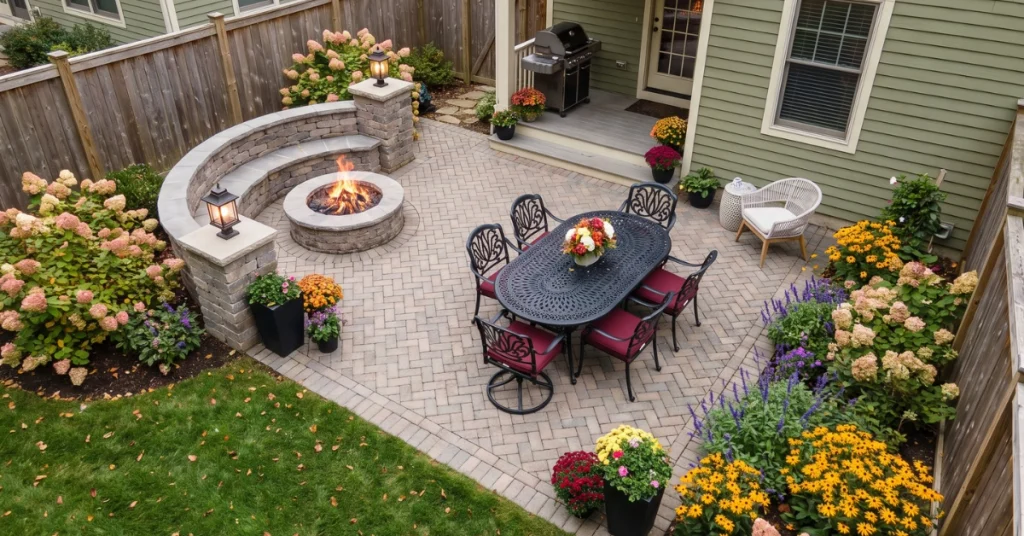
Design a garden made for people with our guide to layouts for entertaining, then get the details right with dedicated seating area planning and practical outdoor dining layouts. If your garden centres on a hard surface, learn how to build the design out from it in our guide to planning a layout around a patio. And for evenings outside, thoughtful lighting layout planning extends every zone well past sunset.
Not every garden is a neat, flat rectangle. Slopes, narrow strips, exposed corners and poor drainage all bring their own challenges — but each one has proven solutions. The trick is planning around the problem instead of ignoring it.
Turn a hillside into an asset with our sloped garden layout ideas, or add drama and usable terraces through multi-level garden design. Make the most of a tight footprint with narrow garden layouts, and design confidently around what you can’t move using our guide to gardening around existing trees. Tame an exposed plot with windy garden layout ideas and solve soggy ground for good with proper drainage layout planning.
The final layer of planning is about how a garden feels: private enough to relax, sunny where you want it, and framed by the views that matter. These decisions are easy to overlook and impossible to fake later.
Design in seclusion from the start with our garden privacy layout ideas, and track the sun so your seating, dining and planting all land in the right spot — see planning your layout for sunlight. Add movement and a sense of calm with a well-placed water feature, and design the whole garden to look its best from indoors with our guide to framing views from your home.
There is no single “correct” garden layout — only the one that suits your plot, your climate and the way you live. Most gardens fall somewhere along a spectrum from strictly formal to loosely natural, and knowing where you want to sit on that spectrum makes every later decision faster.
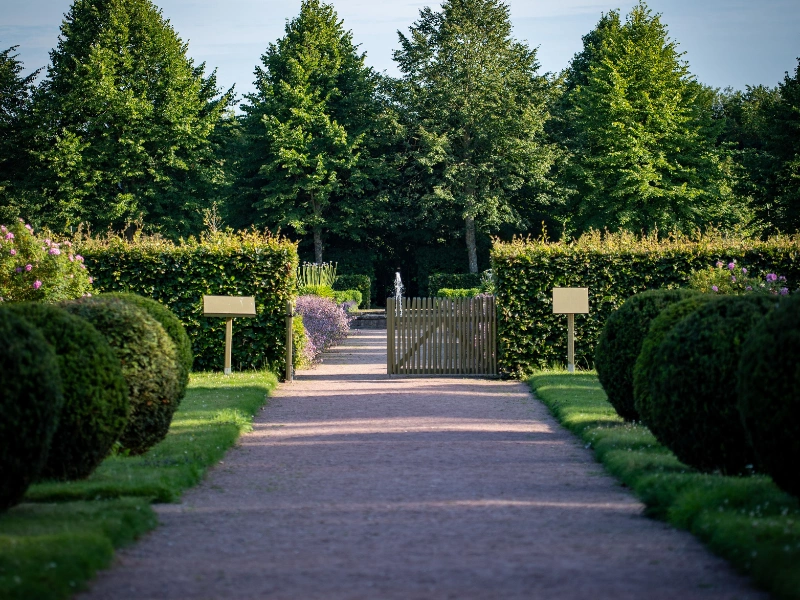
Formal and geometric. Straight lines, clipped hedges, mirrored beds and clear axes give a garden a sense of order and calm. Formal designs read as intentional even before the planting matures, which makes them a smart choice for front gardens and small courtyards. If this appeals, our guide to symmetrical garden layouts shows how to build balance without the space feeling stiff, and a strong entrance layout completes the effect from the very first step.
Relaxed and natural. Sweeping curves, informal planting and soft, blurred edges create a garden that feels like it grew there on its own. This style hides boundaries beautifully and works especially well on irregular plots. Start with our curved garden layout ideas, and think carefully about border and edge planning — in a natural garden the edges do a lot of quiet work.
The classic middle ground. Most real gardens blend the two: a formal terrace near the house softening into looser planting further out, or a neat central lawn framed by relaxed beds. This mix gives you structure where you need it and ease everywhere else. Whichever direction you lean, let one or two strong focal points hold the whole composition together.
Whatever style you choose, keep it consistent. A garden that mixes too many looks feels chaotic. Pick a direction early in your garden layout planning and let it guide the shape of your paths, beds and boundaries.
Layout and planting are two halves of the same job. The best-planned structure falls flat with the wrong planting, and the finest plants look messy without a frame to hold them. Plan the two together and each makes the other look better.
Think of your bed layout as the container and your planting as what fills it. Wide, generous beds give you room to layer plants by height — tall at the back, mid-height through the middle, low and spreading at the front — while narrow beds limit you to a single ribbon of colour. This is why bed shape and planting ambition have to be decided at the same time, not one after the other.
Sunlight ties it all together. Sun-loving plants sulk in shade and shade-lovers scorch in full sun, so mapping light across your plot — the core of planning for sunlight — tells you not just where to sit, but where each plant belongs. The same map guides where to place a cooling water feature or a shady seating nook.
Existing trees deserve special respect here. Their roots, shade and scale shape everything nearby, and fighting them is a losing game. Our guide to gardening around existing trees shows how to plant beneath and around them so a mature tree becomes the garden’s greatest asset rather than its biggest obstacle. And in every bed, keep scale and proportion in view — a border that’s too shallow for the plants you love will always look cramped, no matter how good the plants are.
A full garden makeover is a big spend, and few people can do it all at once. The good news is that a proper plan is exactly what lets you build slowly without wasting a penny — because every phase you complete still fits the finished design.
The rule is simple: build from the ground up, and do the disruptive work first. Anything that involves digging, levelling or heavy machinery — drainage, terracing a slope, laying paths and hard surfaces — should happen before you plant anything precious. It’s far cheaper to route a drain through a bare plot than to dig up an established border two years later.
Once the structure is in, planting and finishing can be spread over several seasons. Fill beds gradually, let hedges and screens grow in for privacy, and add lighting, seating and a water feature as budget allows. Because the plan already reserves a place for each of these, nothing you add later feels bolted on.
This phased approach is the single biggest argument for drawing a proper garden master plan before you start. It turns a daunting, expensive project into a series of small, affordable, satisfying steps — and it means the mistakes covered in our garden planning mistakes guide simply never get the chance to happen.
If you only take one thing from this guide, take this order of operations. Working through these steps in sequence saves money, prevents rework, and gives you a garden that hangs together from day one.
Step 1 — Measure and map. Get accurate dimensions of your plot, mark the house, boundaries, existing trees, slopes and where services run. Everything else is built on this survey, so it’s worth doing carefully. Our guide to measuring your yard walks through the exact method.
Step 2 — Watch the sun and the wind. Note where the sun falls at different times of day and which corners are exposed. This single observation decides where your seating, dining and sun-loving plants should go. See planning for sunlight and, for open sites, windy garden ideas.
Step 3 — List your zones. Write down every function the garden needs to serve, then group them. This is the heart of garden zoning, and it’s what stops a garden from becoming one undifferentiated lawn.
Step 4 — Decide the shape and flow. Choose an overall geometry — symmetrical, curved, or a mix — and rough in the paths that will connect your zones. Keep scale and proportion in mind throughout.
Step 5 — Place the big pieces. Position your patio, lawn, beds, seating and any water feature. If a patio or existing tree is fixed, design outward from it — see layout around a patio and designing around trees.
Step 6 — Add focal points and finishing layers. Choose your focal points, plan the lighting, and refine your beds and borders. Then draw the whole thing up as a garden master plan you can build from, one phase at a time.
Working in phases? A master plan lets you build a garden gradually without wasting money. Lay in the paths and structure first, then add planting, seating and lighting as budget allows — every stage still fits the finished picture because you planned the whole thing up front.
Yes — arguably more so. In a small garden every mistake is more visible and harder to disguise, so a clear plan matters even more. The same principles of zoning, shape and proportion apply; you’re just working at a tighter scale. Start with narrow garden layouts if space is your main constraint.
Diagonal paths, curved lines that hide the boundaries, a strong focal point drawing the eye to the far end, and clear zones all make a modest plot feel larger. Our guides to curved layouts and focal points cover the specific techniques.
Skipping the measuring and diving straight into planting. The second most common is getting scale wrong — skinny beds, an undersized patio, a path too narrow to walk comfortably. We break down the full list in common garden planning mistakes.
Start small and sequential. Measure the space, then read how to plan a garden layout and work through one decision at a time. You don’t need to solve the whole garden at once — you need a plan you can build in stages.
Lorem Ipsum has beenthe industry’s standard dummy text ever since 1966, when designers at Letraset and James Mosley, the librarian at St Bride Printing Library in London, took a 1914 Cicero translation and scrambled it to make dummy text for